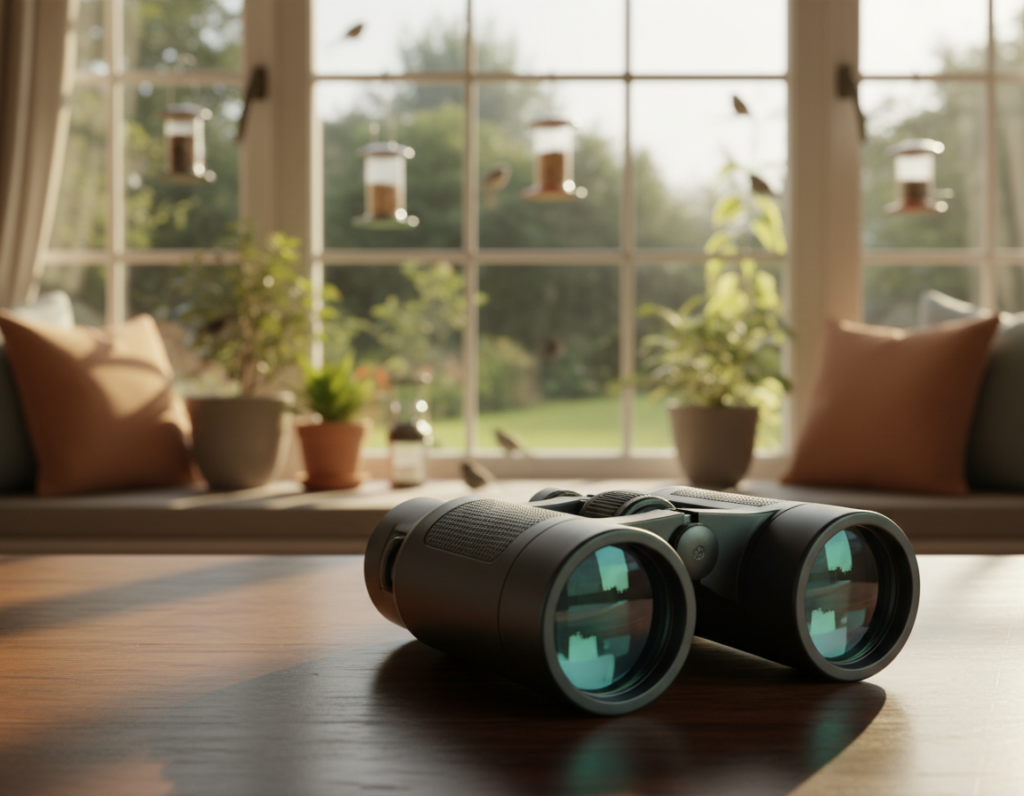
Choosing the right optics changes how wildlife appears from a balcony. The Swarovski NL Pure 8×32 is often cited for its wide field and ergonomic design. Many birders favor 8x magnification because it gives a steady image and a broad view that helps track movement.
Quality glass, ED elements, and multi-coated lenses boost brightness and color. A reliable pair reduces eye strain and improves detail when the light fades. Proper care—clean lenses and a dry case—keeps the instrument ready and extends performance.
Value and price matter. Models like the Vortex Viper HD 8×42 balance performance and cost for many users. Focus ease, objective size, and coatings shape the day-to-day experience. With the right choice, a balcony becomes a clear window into local birding life.
Why Apartment Birding Requires Specialized Optics
Observing birds from a balcony demands optics that focus quickly and show crisp detail at short range. In tight urban spaces, a short close-focus range reveals feeder behavior and plumage detail that distant-oriented models miss.
Portability and speed matter. A lightweight pair that they can grab and raise in seconds increases chances to catch fleeting visits. Wide fields help track birds as they dart between branches near the building.
High-quality glass and coatings reduce eye strain during long dawn or dusk sessions and keep the image bright even in low light. Advanced users often prefer ED glass to limit color fringing when birds sit against bright skies.
“A short close-focus and broad field changes the viewing game on balconies,”
- Short close-focus lenses reveal feeder-side details.
- Wide field of view aids quick tracking of fast-moving birds.
- Ergonomic, lightweight design improves steady holding and long-session comfort.
Choice and value hinge on matching magnification and field to your conditions. Models like the Opticron Savanna WP 6×30 offer a wide view at a modest price, making them practical options when space and speed matter most.
Understanding the Best Binoculars for Apartment Birdwatching
Choosing optics with fast focusing and wide edge-to-edge clarity makes a visible difference on a balcony. Testers judge image quality by focus speed, color fidelity, and how sharp the field remains toward the edges.
The Swarovski NL Pure 8×32 often ranks at the top thanks to an expansive field and comfortable handling that reduces arm fatigue during long sessions. The GPO Passion ED 8×42 is known as a strong all-round option that blends performance and value.
Maven B1.2 10×42 brings high-end glass and a rugged magnesium chassis, useful when birds perch close to buildings and fine detail matters. Side-by-side comparisons reveal real differences in clarity, ease of finding subjects, and low-light brightness.
- Balance optical performance, build quality, and price when choosing a pair.
- Look for phase-corrected prisms and dielectric coatings to boost image brightness and color.
- Ergonomics and focusing ease reduce hand fatigue and improve tracking of quick bird movements.
“Proper testing highlights handling differences and the speed with which a model finds and holds a bird.”
The Importance of Magnification for Balcony Views
Magnification changes how much of the scene a viewer sees and how steady that scene appears in hand. Too much power shrinks the visible field and makes tracking quick birds harder. Observers should weigh detail against usability when selecting a pair of optics.
High power has real trade-offs. Models at 12x or 14x deliver extra reach, but they also narrow the field and amplify image shake when held. That can make it harder to keep a moving bird in the frame.
The Drawbacks of High Power
Higher magnification often reduces brightness and depth of focus. Images can seem dimmer at dawn and dusk, and small head movements blur fine details.
Specialized image-stabilized options, such as the Kite APC 14×50, overcome shake with tech. Those units add price and weight but let users get long-range views without a tripod.
Finding the Magnification Sweet Spot
An 8x magnification is widely seen as the sweet spot for general birding. It offers a wide field view, steady images, and easier focusing while keeping a good balance of brightness.
- Locate and track: A wider field makes spotting fast birds simpler.
- Stability: Lower power reduces hand shake and keeps images sharp.
- Light and weight: A 42mm objective often balances brightness and manageable weight.
“The sweet spot around 8x gives most birders the best compromise between detail, brightness, and ease of use.”
Why Field of View Matters for Fast Moving Birds
A generous field of view helps a watcher keep fast-moving birds in frame without constant re-acquisition.
The field of view is the width of the scene visible through the binoculars and it directly affects how quickly a viewer can locate small, fast birds.
Lower magnification typically yields a wider field, which makes scanning a skyline or tree line much faster. The Swarovski NL Pure 8×32 gives about 450 ft at 1,000 yards, while the Hawke Frontier 8×42 ED X offers roughly 426 ft—both excellent examples of how a wide field view aids tracking.
Wide field view speeds up target acquisition but can introduce edge distortion in some designs. High-quality glass and careful eyepiece design minimize that effect so images stay sharp to the rim.
- A wide field view lets birders follow warblers, swallows, and other quick flyers with less panning.
- Comparing field measurements between similar magnification models reveals real performance differences.
- Prioritize edge-to-edge sharpness so the wider field doesn’t come with distracting distortion.
“A broader field reduces search time and keeps the subject in context with its surroundings.”
For a deeper look at how field impacts tracking, see this field comparison guide.
Evaluating Objective Lens Size for Light Gathering
Objective lens diameter strongly influences how much usable light reaches the eye at dawn and dusk. That affects perceived brightness, color, and the detail visible when birds sit against dim skies.
The exit pupil is the diameter of the light column leaving the eyepiece. It is calculated by dividing the objective lens by magnification. A 42mm objective paired with 8x yields about a 5.25mm exit pupil, a common choice that balances brightness and weight.
Exit Pupil and Image Brightness
Larger objectives gather more light, but they add bulk and raise the price and carry weight of the pair. Fifty-millimeter lenses boost low-light performance but can become heavy during long sessions.
- Practical balance: 42mm often gives solid image quality without excess weight.
- Small, smart designs: A 6×30 like the Opticron Savanna WP achieves a 5mm exit pupil and performs well at dusk.
- Personal factors: Older eyes dilate less, so an enormous exit pupil may be unnecessary.
“Match objective lenses and exit pupil to your typical light conditions and carrying needs.”
For guided advice on selecting optics and testing exit pupil impact, see this choosing a pair.
The Role of Anti-Reflective Lens Coatings
Lens coatings act like tiny filters that keep useful light flowing to the eye while blocking reflections. That process boosts brightness and contrast so an image looks clearer in low light.
Fully multi-coated optics can push transmission toward 95% across many air-to-glass surfaces. Dielectric mirror coatings on roof prisms further preserve image brightness and color fidelity.
The Hawke Frontier 8×42 ED X adds water-repellent layers to the outer lenses. That helps maintain a clear view during wet conditions and keeps images usable when light is poor.
- Maximize light: Coatings reduce loss at each surface, yielding a brighter field and sharper image.
- Reduce fringing: Proper treatments limit color fringing on high-contrast edges.
- Protect views: Water-repellent and anti-glare layers keep a pair usable across varied conditions.
“Investing in premium coatings often improves perceived performance more than a small jump in magnification.”
Achieving Speed and Precision with Focus Mechanisms
A quick, reliable focus wheel turns fleeting glances into clear, usable sightings. A responsive focus system helps a watcher move from near feeders to distant treetops without losing the subject.
High gear ratio benefits
High Gear Ratio Advantages
High gear ratio mechanisms let a user sweep from close focus to infinity in one or two turns. That speed is ideal when scanning a wide field or checking a lake where birds appear and vanish quickly.
The Nikon Monarch M7 10×42 and similar designs show how effortless rapid scanning can be. A fast wheel improves overall performance and increases the chance of catching transient images.
Low gear ratio precision
Low Gear Ratio Precision
Low gear ratio focus gives fine control. It is useful when a bird holds still and small adjustments yield a pin-sharp view.
The Maven B1.2 10×42 is praised for a focus wheel that balances speed and micro-adjusting accuracy. The Vortex Viper HD 8×42 adds a 6.0-foot close focus that helps birders study nearby plumage without disturbance.
- Speed matters: fast focus captures quick moves.
- Precision counts: low ratio refines a sharp image.
- Test the wheel: avoid slack or sloppiness when evaluating a pair.
Why Eye Relief is Critical for Eyeglass Wearers
Eye relief is the distance from the ocular lens to the point where a viewer can see the full field of view without vignetting. It directly affects whether a person wearing glasses can enjoy a complete image while birding from a balcony or yard.
The rule of thumb is clear: aim for at least 15mm of eye relief. Models like the Zeiss Victory SF 10×42 supply about 19.0 mm, and the Nikon Monarch M7 10×42 offers 17.0 mm. Both make it easy to keep glasses on and still see the whole field.
Adjustable eyecups—typically twist-up designs—let a user lock in the correct distance for their lenses. This feature preserves brightness and sharpness of the lenses while preventing discomfort.
“If you have astigmatism, you will likely need to keep your glasses on while using optics to ensure the sharpest possible image.”
- Test with glasses on: always try a pair with your spectacles before you buy to confirm the field view.
- Diopter limits: removing glasses can work for some, but not for astigmatism sufferers.
- Balance trade-offs: long eye relief sometimes trims the field slightly, so evaluate image and magnification together.
Ensuring Durability with Fog and Waterproofing
Durable sealing and gas purging keep optical assemblies clear when temperatures shift quickly. Many quality binoculars use nitrogen or argon fills to prevent internal fogging. That matters when a watcher moves from a warm room to a cold balcony.
Top models are O-ring sealed to block moisture, dust, and debris from reaching delicate prisms and lenses. This preserves image clarity and long-term performance.
Waterproofing is essential in humid climates or during unexpected rain. Affordable options, like the Nikon Trailblazer ATB Waterproof 10×25, show that a low price need not mean poor protection.
A rubber-armored chassis adds impact resistance and a secure grip in wet weather. High-end pairs, such as the GPO Passion ED 8×42 with a magnesium chassis, offer extra ruggedness for rough use.
- Durability counts: sealed internals and dry-gas fills prevent fog and protect image quality.
- Weather ready: waterproof designs keep a pair functional in rain and humidity.
- Build and value: armor and strong frames improve handling and long-term value for birders.
“Choose optics rated as both waterproof and fog-proof to ensure reliable field view and lasting performance.”
Balancing Weight and Ergonomics for Long Sessions
Weight distribution often matters more than raw mass when someone plans multi-hour observation. A rear-biased balance point, like the one on the Zeiss Victory SF 10×42, reduces forearm fatigue and keeps the view steady during long sessions.
The Vortex Diamondback HD 8×42 shows how a light full-sized option (about 23.1 ounces) eases long days in the field. The Celestron Nature DX 8×42 is slightly lighter and gives beginners a comfortable pair without sacrificing image quality.
- Ergonomic grips and thumb indents help steady the binoculars and improve handling in cold or wet conditions.
- Heavier models can boost stability, but only when the design avoids a front-heavy feel that tires the forearms.
- Try gear on for several minutes; real testing reveals how balance affects focus and tracking of fast birds.
Comfort drives frequency of use. A well-balanced pair delivers better long-term performance and greater value at a sensible price.
Premium Choices for Discerning Birders
Top-tier optics deliver a noticeable jump in clarity that reveals tiny feather patterns and subtle color shifts. The Swarovski NL Pure 8×32 often stands out as the best binoculars in this class thanks to an expansive, immersive wide field view.
Zeiss Victory SF 10×42 is praised for exceptional brightness and an ergonomic balance that eases long sessions. The Leica Noctivid 10×42 competes closely, offering razor-sharp detail and superb color fidelity from premium glass and advanced lenses.
Many premium models use fluorite-containing ED glass to reduce fringing and boost contrast. These design choices justify a higher price when the goal is long-term performance and top optical quality.
- Unmatched edge-to-edge sharpness: field flatteners keep the view crisp across the frame.
- Refined mechanics: fast, precise focus wheels and balanced weight reduce fatigue.
- Built to last: durable coatings and sealed construction protect investment-grade optics.
“For those who demand ultimate clarity, premium glass and design deliver a clear, lasting advantage.”
Mid-Range Options for Reliable Performance
A well-chosen mid-range pair often gives the most noticeable step up from entry-level gear. These models usually blend ED glass, quality prisms, and solid mechanics without the premium price jump.
The GPO Passion ED 8×42 stands out as a mid-range binocular that delivers near-professional performance. It pairs bright lenses with a magnesium chassis and robust roof prisms to stay light and durable in daily use.
The Hawke Frontier 8×42 ED X is widely praised as a top selection under many price caps. It includes dielectric coatings and phase-corrected prisms that boost color and contrast in varied light.
The Vortex Viper HD 8×42 adds a wide field view and reliable focusing, making it a favorite among frequent observers who want strong performance without a steep cost.
- Durable build: magnesium frames and waterproof seals hold up to regular use.
- Optical quality: ED glass and quality coatings improve clarity and reduce fringing.
- Practical choice: mid-range gear gives about 90% of premium performance at a lower price.
“Mid-range binoculars often deliver the best balance between image quality and ongoing value.”
Budget-Friendly Picks for Casual Observers
Affordable glass now gives many newcomers a welcome, reliable introduction to local wildlife watching. Casual observers can enjoy clear daytime views without a large spend.
Top practical choices include compact and full-size options that balance price and performance. The Opticron Savanna WP 6×30 is ideal for kids and backyard use thanks to a wide field view and steady handling.
The Celestron Nature DX 8×42 delivers excellent image quality at a modest price and competes with models that cost much more. The Nikon Trailblazer ATB Waterproof 10×25 is a light, portable pick for a tight budget.
Many budget models use BAK-4 glass. That yields good clarity and brightness in daylight. Small trade-offs, like slight color fringing, are common but rarely limit casual use.
- Low cost, high value: accessible entry to the hobby.
- Durable options: many are waterproof and fog-proof.
- Portable picks: keep one in a bag or car for spontaneous spotting.
- Learn affordably: a modest pair helps users refine needs before upgrading.
“You don’t need to spend thousands to enjoy observing local wildlife.”
Tips for Steadying Your View from a Balcony
Stabilizing optics on a narrow balcony turns short looks into reliable identifications. Small changes in setup and posture can cut shake and make details readable. The goal is a steady field and a comfortable stance so sessions last longer.
Using Tripod Adapters for Stability
A tripod adapter is the most effective tool to eliminate image shake when observing from a fixed spot. It lets a watcher mount their binoculars on a camera tripod and enjoy rock-solid views. That setup often improves perceived quality and long-session performance.
If a tripod is not available, resting elbows on the railing or placing a beanbag cushion under the optics works well. Image-stabilized models, like the Kite APC 14×50, offer another route at higher magnifications.
- Tripod adapters give the steadiest view and can be found at modest price points.
- Railing rests or soft supports reduce hand shake quickly and without gear.
- Practice a relaxed grip and steady posture to make handheld use more reliable.
“A steady view is the key to unlocking detail and confident identification.”
How to Properly Maintain Your Optical Gear
Treating optics like precision tools prevents costly wear and keeps the instrument ready for any session.
Clean gently and often. Use a lens pen or a soft microfiber cloth to remove dust and smudges. Never reach for paper towels or household cleaners; those can scratch coatings and harm the lenses.
Keep the caps on when the unit is not in use and store it in a cool, dry case. If the gear gets wet, let it air dry completely before packing it away to avoid mold and mildew.
Avoid touching the glass with fingers. Oils from skin attract dust and can degrade anti-reflective coatings over time.
- Routine checks: inspect the hinge and focus mechanism for grit and smooth travel.
- Post-trip care: gently clean if used near salt spray or dust to protect long-term performance and quality.
- Storage tip: use supplied lens caps and a protective case to guard the glass and mechanics.
“A well-maintained pair is a reliable companion that extends service life and preserves image quality.”
Conclusion
Picking the right gear brings backyard wildlife closer to home. By weighing magnification, field of view, optical quality, and handling, a watcher can match equipment to their space and habits.
Ergonomics and durability matter as much as glass. A comfortable, weatherproof pair encourages longer sessions and makes identification easier in shifting light.
With regular maintenance and a few steadying techniques, a balcony becomes a reliable hide. They will find that the right optics and a little practice turn everyday visits into satisfying discoveries.