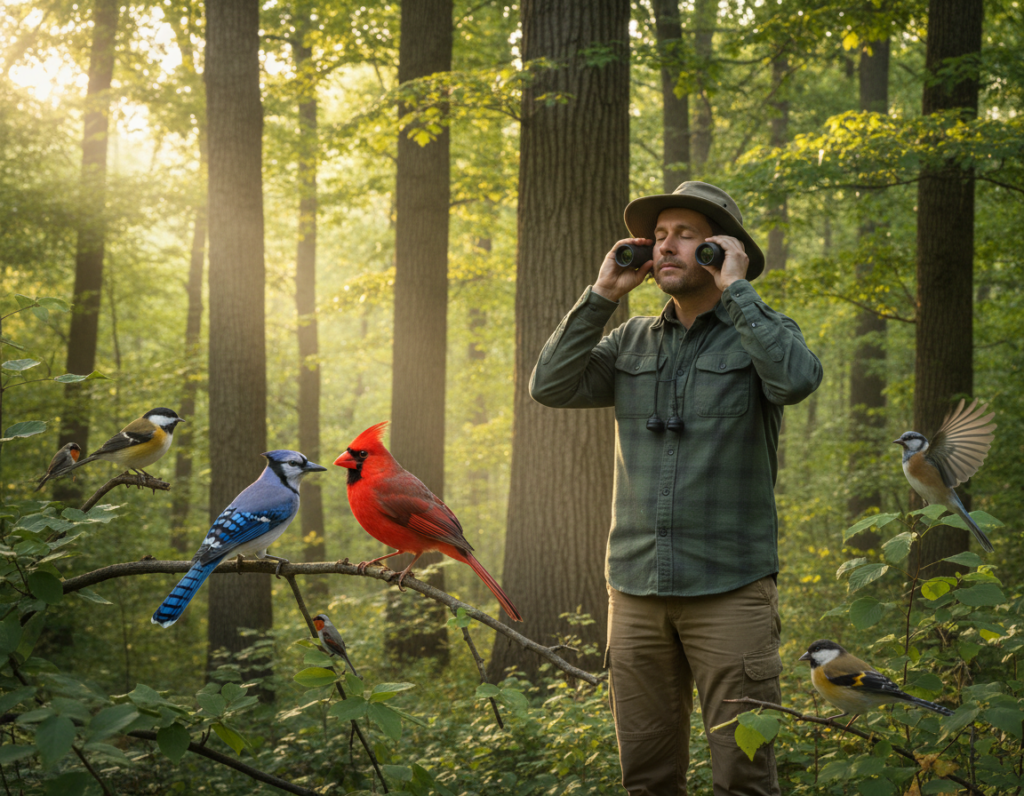
Urban naturalists increasingly rely on mobile tools to monitor how changing months alter local wildlife. The Cornell Lab of Ornithology reports that over 15 million people in the United States use a smartphone app to identify birds today. This widespread use links casual observation with rigorous ecological data.
Modern bioacoustic systems process high-fidelity audio—BirdNET, for example, works at 48 kHz—to capture subtle vocal shifts across species. Those shifts matter: many species sing more during spring breeding and much less in winter. Tracking these patterns helps improve identification and overall accuracy in crowded soundscapes.
By combining precise date and geographic metadata, advanced tools let users refine lists and contribute usable data. Engaging the birding community turns isolated recordings into shared datasets that reveal how urban acoustic environments evolve.
In short, leveraging apps and bioacoustic tools gives observers a practical way to monitor vocal behavior and boost identification accuracy across seasons.
– Smartphone apps bridge casual observation and scientific data.
– High-quality audio and metadata improve identification accuracy.
– Community-collected recordings reveal urban vocal trends.
The Dynamics of Seasonal Bird Vocalizations
Spring triggers a surge of complex vocal displays as males stake territory and court mates in urban green spaces. These shifts affect how researchers and enthusiasts approach acoustic monitoring in cities.
Breeding Season Complexity
During the breeding phase, many male songbirds expand repertoires and produce layered songs to claim territory and attract mates. This peak in vocal complexity helps distinguish one species from another and improves field identification when recordings are clear.
Migratory Call Patterns
By contrast, migrating groups favor short, high-frequency calls that maintain flock cohesion. Such calls are brief and repetitive, optimized for long flights and quick exchanges in noisy urban corridors.
“Short, repeated signals allow moving flocks to stay coordinated across long distances.”
- The complexity of songs peaks in spring.
- Many species use specific songs calls for alarm or coordination.
- Migratory calls are brief and aid flock cohesion.
Understanding these phases improves identification and gives scientists data to track arrival and departure patterns across urban landscapes.
Factors Influencing Seasonal Bird Sound Recognition Accuracy
Accuracy in automatic identification depends on more than algorithms; it hinges on ambient conditions and the quality of each recording.
Data from the Cornell Lab of Ornithology shows that sound-based identification grew by 35% annually since 2022, driven by millions of users who rely on apps. Merlin Bird ID alone holds over 300,000 clips from more than 2,000 species, giving developers vast coverage to train models.
Practical factors change how well tools identify birds. Time of day matters: dawn choruses create dense layers of calls and songs that lower confidence. Wind, rain, and traffic degrade a recording and reduce identification scores.
- Time of day: dawn and dusk increase acoustic complexity.
- Environmental noise: weather and traffic lower clarity.
- Frequency range: varied species vocalize across broad ranges, requiring advanced processing.
- Human learning: ear training remains crucial when visual cues are absent.
“Learning to identify by ear is a foundational skill for serious naturalists.”
Technological Approaches to Urban Bioacoustics
Today’s urban bioacoustic stacks pair always-on recorders with neural nets to boost identification and data quality. This mix lets researchers and enthusiasts collect usable audio without constant oversight.
Smartphone App Capabilities
Modern smartphone apps run lightweight models that process short clips in real time. Many apps analyze 3-second segments at high sample rates to match neural network inputs.
These apps support photos, metadata, and quick sharing. They help users build lists and contribute to community datasets.
Dedicated Monitoring Hardware
Devices like the Haikubox provide continuous recording and low-power operation. They capture long stretches of ambient audio that apps may miss during brief field sessions.
Neural Network Processing
Systems such as BirdNET use a Convolutional Neural Network to scan spectrograms for species patterns. Processing standardized features helps isolate faint calls from busy city noise.
- Real-time identification: models flag likely species instantly.
- Custom options: users select filters to improve accuracy and suggestions.
- Edge efficiency: embedded models run on low-power devices while preserving identification levels.
“Neural feature extraction turns complex soundscapes into actionable ecological data.”
For a technical review of methods and model performance, see the bioacoustic review.
Challenges of Identifying Birds in Noisy Urban Landscapes
High background noise in metropolitan areas forces monitoring tools to separate target signals from clutter. Urban life fills recordings with traffic, sirens, and human chatter that overlap the frequency range of many calls and songs.
Filtering Anthropogenic Noise
Advanced filters and model training help isolate vocal elements that matter for identification. The Haikubox, priced at $399, is trained to ignore human speech and many man-made sounds to improve recognition accuracy.
Still, devices have limits. The Bird Buddy feeder captures crisp photos with its 5-megapixel camera, yet visual confirmation often remains necessary when audio is unclear.
- Urban noise can mask weak calls and reduce identification confidence.
- Algorithms must focus on the right frequency range and levels to separate species from clutter.
- Strategic placement of devices and timed recordings improves the chance of clean audio.
“Community corrections and periodic software updates raise long‑term accuracy by teaching tools real-world errors.”
Combining good hardware, smart apps, and community input gives researchers better data over time. This layered approach helps identify birds and refine identification in busy city habitats.
Leveraging Community Science for Better Data
When everyday observers share clips and photos, research-grade datasets grow rapidly and become more representative. BirdNET, an open-source project, depends on this kind of global collaboration to refine models and improve identification.
Millions of observations from citizen scientists help tune biogeographical priors so apps can suggest the right species for a place and time. Contributors upload audio and pictures through an app and join a community that values careful reporting and peer feedback.
The collaborative feature of these platforms links experts and beginners. That mix speeds learning and raises data quality. Volunteers gain practical skills in birding and data collection while researchers receive diverse, real-world samples.
- Community science empowers millions to track species movement and health.
- Shared photos and recordings supply vital inputs for identification models.
- Open datasets enable peer-reviewed science that supports conservation.
“Public participation turns everyday observations into a powerful resource for ecological research.”
Future Trends in Automated Bird Monitoring
On-device models are poised to put powerful identification tools directly into users’ pockets. Mobile integration with TFLite will let apps run offline and return fast, reliable results from short audio clips.
Real-time dashboards such as BirdWeather will expand coverage and show migration waves as they happen. Researchers will use these live visualizations to map movement and behavior across regions.
Community-collected data plus improved neural nets will raise overall identification accuracy. Models will learn from verified uploads, giving more useful suggestions tailored to each user.
- AI on smartphones enables instant identification without connectivity.
- Expanded dashboards improve data coverage for migration tracking.
- Personalized tools offer location-based suggestions and options.
“Combining community science with advanced machine learning will transform monitoring and science.”
For practical options and sample setups, see this automated monitoring options to explore device choices and workflows.
Conclusion
Conclusion
Practical field habits and modern models sharpen identification and deepen ecological insight. Recording clearly, noting time and place, and sharing clips give researchers useful data. This requires a strong, shared commitment from hobbyists and professionals.
Improved tools and community input steadily raise overall accuracy. Contributors support open science while learning to interpret vocal cues. That cooperation accelerates model improvements and makes monitoring more accessible.
Ultimately, the future of urban nature study rests on the bridge between human observation and artificial intelligence. Together they turn everyday listening into meaningful research and lasting conservation gains.